Creating Depth and Drama with Mountains and Moonlight Layered Wall Art
There is a profound sense of tranquility that comes from gazing at a night sky where the peaks of rugged mountains seem to brush against the luminous surface of the moon. Capturing this ethereal moment in physical form allows crafters and home decor enthusiasts to bring a piece of that serenity into their living spaces. Mountains and Moonlight Layered Wall Art offers a sophisticated solution for creating stunning three-dimensional displays that play with light, shadow, and perspective. Whether you are a seasoned woodworker looking to expand your portfolio or a paper crafting enthusiast seeking intricate designs for scrapbooking, this versatile digital asset provides the foundation for high-impact creative projects.
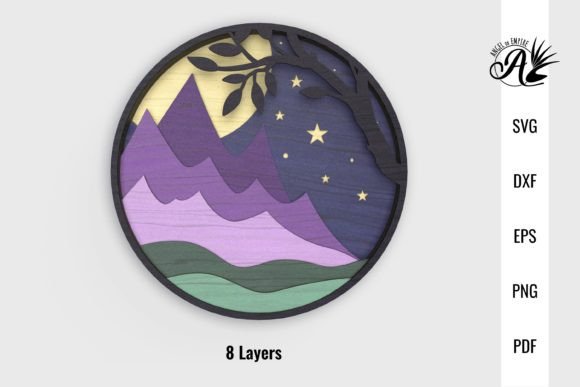
The core appeal of this design lies in its ability to transform flat materials into dynamic visual experiences. By utilizing an eight-layer structure, the artwork mimics the atmospheric perspective found in nature, where distant objects appear lighter and less distinct than those in the foreground. This technique adds a level of professionalism and depth that single-layer cutouts simply cannot achieve. For creators, the challenge often lies in finding designs that are both aesthetically pleasing and technically feasible across various scales. This specific design addresses that need by offering a balanced composition that works equally well as a modest six-inch diameter accent piece or a grand statement wall installation.
Versatility Across Materials and Scales
One of the most significant advantages of using Mountains and Moonlight Layered Wall Art is its adaptability. Many digital designs are rigid, intended for one specific medium or size, which limits their utility for multi-disciplinary crafters. In contrast, this design was engineered with flexibility in mind. The base diameter of six inches serves as an ideal starting point for smaller projects, such as wooden window hangings, ornament tags, or detailed greeting cards. However, because the files are provided in vector formats, they can be scaled up infinitely without losing resolution. This means you can confidently expand the design to create large-scale wall art that dominates a living room or bedroom backdrop.
For those working with wood, the layered approach allows for beautiful experimentation with different stains and finishes. You might choose a dark walnut for the foreground layers to create silhouette effects, while using lighter birch or maple for the background layers to represent the misty distance. The interplay between the wood grain and the laser-cut edges adds texture and warmth to the final piece. Conversely, paper crafters can utilize the same files to create delicate shadow boxes. By using cardstock in varying shades of blue, grey, and white, you can replicate the cool tones of a moonlit night. The precision of the cut files ensures that even intricate details, such as the subtle curves of the mountain ridges, remain crisp and clean, regardless of the material thickness.
Customization for Personal Expression
Creativity thrives on customization, and this design empowers users to tailor the scene to their specific aesthetic preferences. The eight-layer structure is not a rigid constraint but a modular system. For instance, if you prefer a daytime landscape over a nocturnal scene, you can simply remove the stars layer. This small adjustment transforms the mood of the piece from mysterious and calm to bright and airy. Similarly, users seeking a more minimalistic look can eliminate intermediate layers to reduce complexity. This modularity is particularly useful for beginners who may find eight layers daunting to assemble. By starting with fewer layers, they can master the alignment and spacing techniques before tackling the full composition.
The inclusion of multiple file formats—DXF, EPS, PDF, PNG, and SVG—ensures that the design is accessible to everyone, regardless of their preferred software or hardware. Vector files like DXF and SVG are essential for laser cutting machines such as Glowforge, OmTech, Silhouette, Cricut, and ScanNCut. These formats allow the machine to read the paths precisely, ensuring smooth cuts and accurate engraving lines. For those who do not own cutting machines, the high-resolution PNG files (300 dpi) can be used for printing and manual cutting, making the design accessible to traditional crafters as well. The fact that all layers are labeled from 01 to 08, with 01 being the top layer, simplifies the assembly process significantly. This clear labeling eliminates guesswork, allowing creators to focus on the artistic aspects of finishing and mounting rather than troubleshooting layer order.
Practical Applications and Project Ideas
The potential applications for Mountains and Moonlight Layered Wall Art extend far beyond standard wall decor. Consider using the design for custom gift items. A smaller version mounted in a deep frame makes for a thoughtful housewarming present or a unique wedding gift for couples who love the outdoors. For educators and parents, the layered concept can be an engaging STEM project, teaching children about perspective, depth, and spatial reasoning through hands-on assembly. Junk journal enthusiasts can incorporate individual elements of the design, such as the moon or specific mountain peaks, as embellishments for their pages, adding a tactile dimension to their storytelling.
When planning your project, consider the lighting environment where the art will be displayed. Layered wall art interacts dynamically with ambient light. Installing LED strip lights behind the layers can create a glowing halo effect, enhancing the moonlight theme and adding a modern touch to the rustic or natural aesthetic. This backlighting technique highlights the separation between layers, emphasizing the 3D effect. For outdoor applications, such as porch decorations, ensure you use weather-resistant materials and sealants to protect the wood or paper from moisture and UV damage.
Technical Considerations for Best Results
To achieve the best results with this design, attention to detail during the cutting and assembly phases is crucial. When using laser cutters, test the power and speed settings on scrap material first. Different woods and papers have varying densities and burn thresholds. Ensuring clean cuts without excessive charring will make the assembly process smoother and the final appearance more polished. For paper projects, using a bone folder to gently press down the layers can help secure them without damaging the delicate edges.
Spacing is another critical factor. The distance between each layer determines the depth perception of the final piece. Using foam tape or spacers of consistent thickness between layers helps maintain uniformity. If you are scaling the design up significantly, you may need to increase the spacer thickness proportionally to maintain the correct visual perspective. Experimenting with different spacer heights can yield surprising results, allowing you to fine-tune the depth to suit your specific display location.
In conclusion, Mountains and Moonlight Layered Wall Art is more than just a digital file; it is a versatile tool for creative expression. It bridges the gap between digital design and tangible art, offering endless possibilities for customization and application. Whether you are creating a serene centerpiece for your home or a intricate gift for a loved one, this design provides the structure and elegance needed to bring your vision to life. By leveraging the flexibility of the file formats and the modularity of the layers, you can create unique pieces that reflect your personal style and technical skill. Embrace the challenge of layered crafting, and let the interplay of mountains and moonlight inspire your next masterpiece.